In the immediate aftermath of the PCRA, the Emergency was still in force. Public criticism of the law was sparse, but even so, one or two newspaper editorials exclaimed that while the PCRA was a good law, increasing punishments did not necessarily lead to deterrence and that stringent enforcement from the state was required to ensure the PCRA was effective.[1]
After the Emergency was lifted and the Janata Party came into power, Prime Minister Morarji Desai announced a five-year plan to uplift Dalits that included tackling the economic roots of the problem, ensuring social and educational programmes for integration would be pursued, and enforcing civil rights laws.[2] Following this, states were asked to set up special courts for untouchability cases.[3]
The Ram Dhan Committee released its report on atrocities on Scheduled Castes and Scheduled Tribes in 1979. The report argues that “atrocities on Scheduled Castes and Scheduled Tribes have a direct link with their precarious economic condition which forces them to work as bonded labour and to borrow… from unscrupulous money lenders. This results in alienation of their land”[4] The report advocated for the implementation of land reforms, redistribution of waste lands, rehabilitation of bonded labourers, implementation of minimum wages and for district-level cells to implement economic reforms. The Committee found that despite the PCRA being enacted law, there was no machinery in the Ministry of Home Affairs to ensure effective implementation and that the machinery that was present in state government was inadequate. The Ministry of Home Affairs had argued that legally and constitutionally, the enforcement of the PCRA and policing and prosecution of atrocities fell under “Law and Order”, a subject in the state list. The Committee argued that since Article 17 was a constitutional protection, the union government “cannot evade its responsibility.” And was required to honour its “constitutional responsibility” and use its discretion to ensure that Dalits and Adivasis did not suffer due to their position in society.[5]
Reports of mass atrocities in response to assertions of education rights and land rights continued to be frequent across India, including in the Marathwada and Bihar regions.[6][7] A 1983 survey conducted by the All India Harijan Sevak Sangh in 12 states found that wells, tanks, temples and public amenities were still not accessible to rural Dalits.[8] Another survey conducted by the Union Home Ministry found “alarming evidence” of an upward trend in crimes against Dalits in Tamil Nadu.[9]
By 1980, editorials in leading newspapers outright stated that the PCRA was ineffectual. The Commission of Scheduled Castes and Scheduled Tribes indicated that improving social relations requires encouraging inter-caste marriages, integration in educational institutions, the empowerment of Dalit citizens, and the union government following through on its responsibilities. [10] The Commissioners report also posited that the entire regime of suppression, segregation and exploitation of Dalits in rural India was sustained by violence. A departure from explanations for the persistence of untouchability as being rooted in economic exploitation. After a short decline during the Emergency, reported incidents of violent crimes and harassment went up by 75% during 1977. The report argues that these instances cannot be treated as ordinary violations of the law.[11] It recommended establishing a separate ministry for Dalit welfare and enacting a comprehensive law to deal with atrocities cases.[12]
In the interim period between the PCRA and the enactment of the POA, the public conversation on empowering Dalit citizens to unify and resist caste atrocities takes many forms; the Union home ministry proposes to arm Dalit citizens so they might protect themselves.[13] Activists and politicians variously call for the induction of Dalits in the police force,[14] creation of village-level securities forces that comprise ex-servicemen,[15] creation of special mobile courts at the village level presided over by laymen Dalits,[16] and training Dalits as paralegals through legal aid schemes at the newly established National Law Universities.[17]
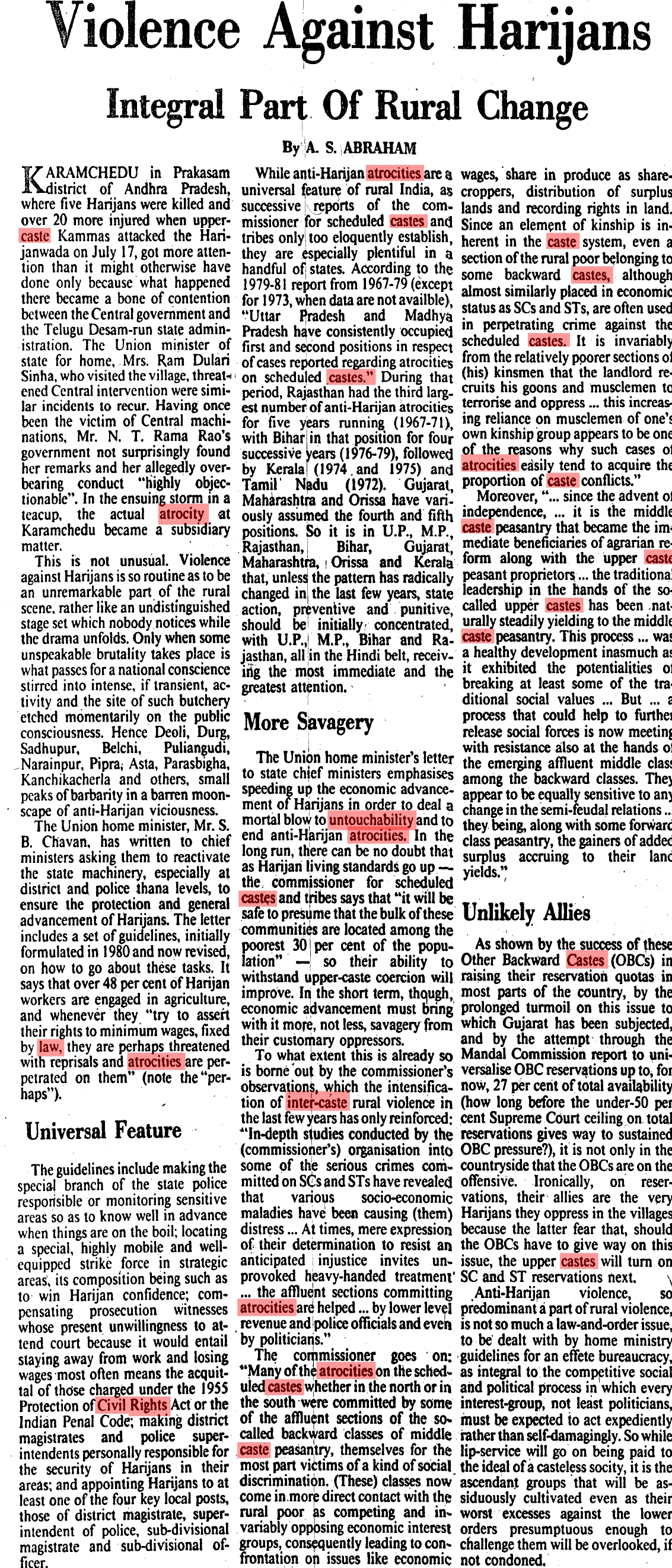
A massacre in Karamchedu in 1985 brings forth new questions on how caste atrocities are to be addressed as a pattern of middle-class and wealthy landowners from backward classes attacking Dalits is revealed.[18] What started as a minor altercation between a Dalit boy and a Kamma boy turned into a horde of the dominant community assaulting an entire colony of Dalits, torturing them, and displacing them. This case becomes a national flashpoint and revitalises the Dalit movement in Andhra Pradesh.[19] Motivating activists to pursue harsher criminal sanctions for caste atrocities.
In November of 1985, the subject of the welfare of Scheduled Castes and Scheduled Tribes was moved from the Ministry of Home Affairs to the newly created Ministry of Welfare. The Sultanpuri Committee disagreed with the change and argued that atrocities were a law and order problem and that the Ministry of Welfare was ill-equipped to direct the implementation of criminal laws. [20] The Sultanpuri Report further argued that atrocities were caused due to social factors including the hierarchical nature of the Hindu Caste system. And that social awakening by Dalits leads to a backlash in the form of caste atrocities and harassment. And that social disabilities are “further reinforced by economic factors like land disputes, forcible harvesting of crops, disputes over payment of minimum wages etc”.[21] An inversion of explanations of untouchability that traced the problem to economic exploitation.
Through this time two important themes emerge within public discourse that impacts how the untouchability problem is to be addressed. The first is the cause of untouchability. Clearly in the immediate aftermath of the Emergency period untouchability and the caste system were viewed as the consequence of economic exploitation often by feudal landlords. However, towards the end of the 1980s , caste and untouchability began to be categorised as independent of and perhaps even reinforcing economic exploitation. There are several explanations for this shift, whether that is the increasing mob violence committed against entire groups of Dalit citizens, the slow creep of neo-liberalism, the erosion of Nehruvian secularist-nationalist political discourse or something else entirely.
But this shift bears importantly on the second theme, which is the question of who bears responsibility for eradicating untouchability. When the Constitution was drafted, Ambedkar’s hope was that the union government would take up responsibility for eradicating untouchability as Article 17 was included in the fundamental rights chapter. He made speeches in parliament specifically referring to union government needing to create additional police, special judicial and administrative machinery, and funding for costs of prosecution as there might be resistance from states that were not keen on or able to enforce the law as noted before in this post. But over time, demands for a separate ministry for addressing issues of Scheduled Castes and Scheduled Tribes, and an emphasis on the economic roots of casteism, led to the subject moving from the purview of the Ministry of Home Affairs to the Ministry of Welfare.
With increasing reports of mob violence targetting Dalit citizens, it was apparent that the Ministry of Welfare would be ill-equipped to deal with the issue and demands to transfer the subject back to the Home Ministry began anew as evidenced by the Sultanpuri report.
Of course, even the passing of the Prevention of Atrocities Act did not result in the affixing of responsibility within the Union Government as they argued that since law and order was a state subject, responsibility for eradication of caste atrocities, and thereby untouchability laid with state governments. Two years after the POA was enacted, MP’s in Lok Sabha discussed the Tsundur Massacre and repeatedly demanded that either a separate ministry for the welfare of Scheduled Castes and Scheduled Tribes be created, or that the subject be brought under the purview of the home ministry. But the last word was perhaps had by J Chokka Rao of Karimnagar constituency when he stated ” Solutions can be found if commitment is there. It does not matter whether the subject is under Welfare Ministry or Home Ministry. Commitment matters more than that of the ministry. Neither the political parties nor the administration has worked sincerely to remove the tension. I consider political parties a big failure. Unfortunately, none of the social organisations are coming forward. Neither any attempts were made to reduce tensions nor responsible social organisations are being formed. only a few are committed in every political party. Collective efforts should be made in the event of such an incident taking place… not on political lines”[22]
Over time, Ambedkar’s vision of an accountable union government taking responsibility for the eradication was entirely lost. The project of affixing responsibility for eradicating untouchability is unfinished as Dalit law makers continue to demand accountability from the union government even today.
[1] ‘Not by law Alone’ The Times of India (12 September 1976) 8.
[2] ‘5 Year Plan to uplift 41 million Harijans’ The Times of India (26 December 1978) 4.
[3] ‘States asked to set up courts for caste cases’ The Times of India (17 May 1979) 1.
[4] Ministry of Home Affairs, Committee on Welfare of Scheduled Castes and Scheduled Tribes (1978-79, 6th Lok Sabha, 30April 1979) 84
[5] Ministry of Home Affairs, Committee on Welfare of Scheduled Castes and Scheduled Tribes (1978-79, 6th Lok Sabha, 30 April 1979) 83-85
[6] ‘Probe into all mass caste strife mooted’ The Times of India (1 May 1979) 13; B.M. Purandare, ‘Caste Hindu-Harijan Tension persists in Marathwada Region’ The Times of India (2 April 1979) 4.
[7] Janak Singh, ‘Plight of Harijans in Bihar: Victims of unbridled repression’ The Times of India, (5 May 1980) 8.; ‘Murder Most Foul’ The Times of India (17 Jan 1988) A3; ‘The Brutalization of Bihar’ The Times of India (June 21 1988) 8.
[8] ‘Law Fails to make dent in caste barrier’ The Times of India (31 March 1983) 23.
[9] ‘Alarming Evidence’ The Times of India (21 November 1979) 8.
[10] N L Chawla, ‘Civil Rights Act Only on Paper’ The Times of India (2 May 1980) 6
[11] K.C. Khanna, ‘Promoting Harijan Welfare: Limitations of the Law’ The Times of India (13 February 1980) 8.
[12] ‘Separate Ministry for Harijans Welfare Urged’ The Times of India (23 December 1980).
[13] ‘Harijans May Get Arms Licenses’ The Times of India (20 March 1980) 1.
[14] ‘Police Posts for Minorities’ The Times of India (5 April 1980) 9.
[15] ‘Harijan Atrocities Exciting Run Chase’ The Times of India (3 March 1983)8.
[16] ‘Roving Judges for villages suggested’ The Times of India (15 April 1987) 20; ‘Involve Harijans in Welfare Schemes’ The Times of India (19 December 1976) 9.
[17] ‘Call to bring Legal Aid to Weaker Sections’ The Times of India (11 September 1989) 10.
[18] Abraham A S, ‘Violence Against Harijans: Integral Part of Rural Change’ Times of India (16 August 1985) 8.
[19] Dag Erik Berg, Dynamics of Caste and Law,pp.103-127.
[20] Ministry of Welfare, Committee on the Welfare of Scheduled Castes and Scheduled Tribes (1985-1986, 11th report, 8th Lok Sabha, 25 April 1986) 15-18
[21] Ministry of Welfare, Committee on the Welfare of Scheduled Castes and Scheduled Tribes (1985-1986, 11th report, 8th Lok Sabha, 25 April 1986) 19
 The Article 17 Project
Leave a comment