In the intervening years between the UOA and the PCRA, B.N. Datar argued that since the government had spent 40 crores on “ameliorating the lot of the Harijans” within the first five-year plan, he was confident that the country would see an end to untouchability within 10 years. This, even as he was reminded by Bombay state legislators that untouchability was still prevalent in rural areas and that the UOA had not been very effective.[1]
Prime Minister Nehru and President Rajendra Prasad gave frequent speeches calling for the upliftment of Dalits and stressing that they needed to assimilate and not separate from the nationalist project.[2]
Dalit activist organisations routinely marched on the streets, even holding mass satyagrahas on the issue of untouchability. They blamed the failure of the UOA on a lack of enforcement by the executive.[3] Some even threatened to exit Hindu society if their concerns were not addressed.[4]
Newspaper editorials from the time stressed that the untouchability problem was unsolved in villages where economic exploitation coupled with landlessness and rampant discrimination stigmatised Dalits severely. They posited that laws passed were ineffective due to lighter prescribed punishments and lack of proper implementation by the legal system.[5] Some editorials and politicians even criticised Dalit leaders for demanding financial concessions for Dalits and reservations in legislatures and educational institutions instead of addressing the problem of untouchability.[6] Other editorials laid the blame squarely on government apathy toward the plight of the Dalits. A few editorials argued that democratic and cultural changes were taking place in rural areas, albeit slowly.[7]
Representatives of the government responded to the public discourse and periodic reports by the Commissioner of Scheduled Castes and Scheduled Tribes by proposing amending the UOA to address any weaknesses and shoring up enforcement.[8] However, concrete legislative action on the untouchability issue was delayed for 20 years until 1976.
In 1968, the Kilvenmeni massacre, where 44 Dalit villagers, mostly women and children, were burned to death in Tamil Nadu by local landlords in retaliation for daring to organise a workers union, is reported by newspapers as shocking the conscience of the nation. However, within three years, this kind of mob violence against Dalits was reported quite often.
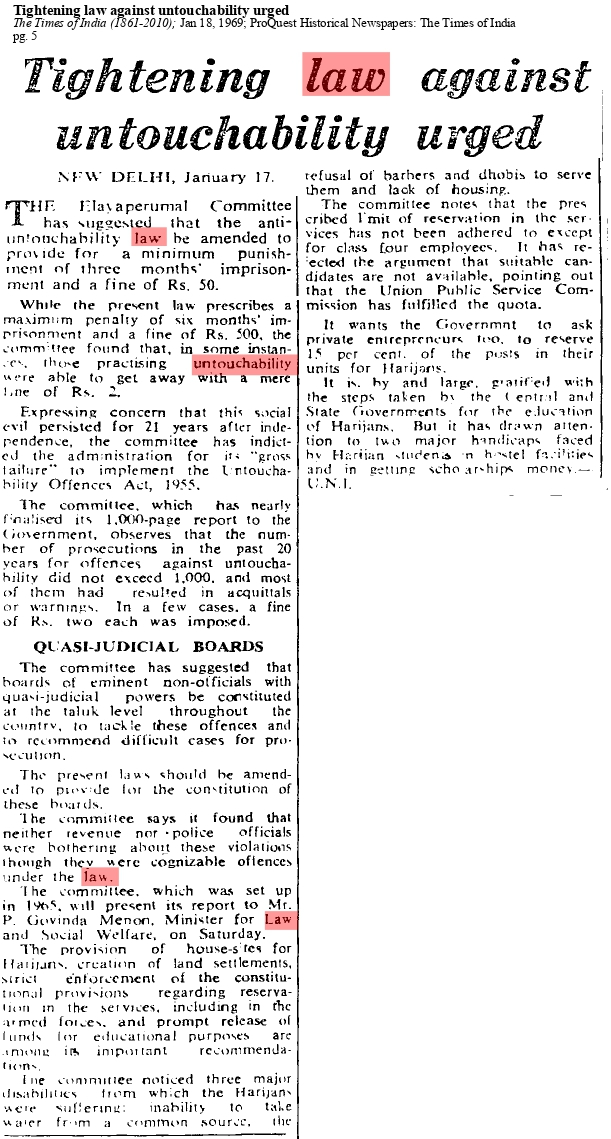
The Elayaperumal Committee report released in 1969, suggested sweeping legal reform in the form of mandatory minimum punishment of three months imprisonment for violations, the provision of housing and land settlements for Dalit citizens, the release of funds for the education of Dalits, the filling of empty reserved positions in the public services and the extension of the reservations schemes to cover private employment. Among other things, the thousand-page report expressed concern that not more than a thousand cases had been registered under the UOA in any calendar year, a gross undercount compared to the incidence of these crimes and that Dalit women particularly faced untouchability and violence when drawing water in rural areas.[9]
MPs in parliament expressed their outrage at the findings of the report, particularly in the context of casteist statements by Shankaracharya of Puri who justified the practice of untouchability as grounded in scripture. They argued that Dalits had been denied a share in the body politic and that the Hindu religion itself was inseparable from untouchability. And demanded that the religious leader be prosecuted[10]
A curious fact about the Elayaperumal report that often goes unnoticed is that the committee recommended that the government allow both criminal and civil legal prosecutions for untouchability as they considered untouchability both a social tort against the individual and a crime against the state. This would allow victims of untouchability to be compensated, and the report states, hasten societal reforms by enabling offenders to repent. It recommended the creation of Taluk-level boards that have: i) an administrative wing, “Haripal”, who carries out propaganda on untouchability laws, assists Dalits seeking to enforce their rights and prosecutes untouchability cases; ii) an investigation section comprising a field examiner who investigates untouchability cases, studies patterns in such cases and reports to the “Haripal” who has powers to compel the attendance of alleged offenders, and iii) a “Hari Adhikaran”, a quasi-judicial wing that could enforce the attendance of parties in dispute, require the production of documents as discovery, grant injunctions to accused persons, and award damages to victims. The quasi-judicial wing was to function as a civil court and adopt a “preponderance of evidence” standard in judging cases. When convinced that village communities had practised untouchability, the Hari Adhikaran could impose sanctions on them, including stopping developmental grants or grants in aid to schools for those communities.[11]
A final note about the Elayaperumal report is that there was one major voice of dissent. R. Achutan, a Dalit MP from the Congress Party wrote that he disagreed with the premise that there was an acute problem of untouchability in the country ” I am not saying that there is no untouchability in the country; I mean only that economic and educational development are the major problems and untouchability is a secondary one” (emphasis his.) He argued that commitment to economic and development would automatically result in the abolition of untouchability, and that tracing out untouchability would be a “wild goose chase”. He went further, arguing that vested interests within and outside the Dalit community sought to spread widespread discontent over untouchability in order to obtain liberal grants from the government. Stating that “Though they themselves are Harijans they mis-utilise the grants from the government and try to keep the Harijans downtrodden for ever for their own benefit. It is these sort of Harijan leaders who are more dangerous than their caste-Hindu enemies”[12]
In 1970, the SC-ST Commissioner, in his report, argued that laws on the books were not enough and that direct action combined with agrarian reforms were required to end untouchability and empower Dalits to assert their rights.[13]
In 1972, an amendment to UOA was proposed in Parliament that introduced a mandatory jail sentence for convicts that was reduced to 1 month and a Rs.50 fine for first offences and increased punishments for subsequent convictions. The proposal was roundly criticised in the press[14] and the parliament as doing too little.[15]
While the MPs were keen to support an anti-untouchability measure, many Dalit and Caste Hindu members from different parties spoke about the necessity of addressing economic causes of untouchability, the urgency of ensuring that state governments and police machinery were held accountable, and the need for broad-based social reform movements that sought to eradicate the caste system. Some MPs disagreed with the bill and argued that punishments should not be reduced, and recommendations of the Elayaperumal Committee should be followed. Since even members of the Congress party expressed dissatisfaction with the bill and said they would vote for it but did not believe in it, Nurul Hassan, the Minister for Education and Social Welfare and Culture, withdrew the bill with the intention to referring it to a Joint Committee of the parliament for further discussion. [16]
The bill stays in the Joint Committee for four years.
Fresh motivation for legislative action on untouchability came about due to the increasing reports of mob violence or “Caste Atrocities.” In Uttar Pradesh alone, there were several incidents reported: the burning of Dalit women and Children in Machhera village, the death of a woman and injuring of 16 in Abhishan Village in Ghazipur in 1971, the setting of fire to Dalit localities in Varanasi or Chahtona in 1972, the murder of Dalit workers for the offence of demanding payment of wages in Agwanpur, or the destruction of houses of Dalits who applied for land allotment under agrarian reform schemes.[17] MPs in the Rajya Sabha were outraged by these incidents, demanded accountability from the executive, and advocated for Dalits to bear arms for their own protection.[18]
By 1973, the Kilvenmani case was decided by the High Court, leading to acquittals of 15 landlords previously convicted by the trial court on the ground that wealthy landlords would not commit such gruesome crimes themselves but would have hired others to do so.[19] This provoked criticism not just of weak laws but of ineffectual policing systems and the courts. By September 1973, the President of India, V.V. Giri, called for the death penalty as punishment for the practice of untouchability.[20]
In the months before the bill was reintroduced in parliament, K.S. Chavda and Vasanth Sathe raised the issue of the untouchability amendment bill often, accusing the government of not wanting to discuss or pass the legislation, and of not wanting to enact multi-pronged approaches to the problem suggested by the Andra Pradesh State Harijan Conference.[21]
It is in this context that the PCRA was first introduced in parliament on May 6th 1975. Only three speakers were allowed to speak on the bill, in addition to Om Mehta, the Minister of State for Home Affairs.
He presented that PCRA amended the UOA and introduced several new caste crimes, including the preaching of untouchability, the dereliction of duty by government officers, collective fines on villages practising social ostracisation, acts of reprisal or revenge against Dalits exercising their “civil rights”, and compelling Dalits to perform scavenging, sweeping, removing carcasses, flaying animals. It also made these cases non-compoundable. And enjoined state and central governments to undertake appropriate measures to ensure that Dalits could avail themselves of civil rights flowing from the act, including providing free legal aid, appointing special officers, and setting up special courts to try these cases. The PCRA increased the punishment for these offences with a minimum sentence of 1 month for a first offence, 6 months for a second offence, and one year for a third offence. It also provided for summary trials in less serious cases. [22]
On 25th June 1975, President Fakhruddin Ali Ahmed, at the behest of Prime Minister Indira Gandhi, declared a state of internal emergency. By 1976, when the PCRA was up for debate in parliament, many members of opposition across party lines were placed under detention. They were thus unable to be in parliament to discuss the bill. In addition, Indira Gandhi unveiled a 20-point economic programme geared to address rural poverty, enforcement of land reforms, housing for people and “Justice for Scheduled Castes and Scheduled Tribes”. [23]
Overnight, India became a quasi-dictatorship, which influenced the nature of parliamentary debates. While Lok Sabha MPs are promised a discussion on the bill in May of 1975, it does not occur as a no-confidence motion against the government moved by Jyotirmoy Basu takes centre stage.[24] The PCRA was passed within ten minutes on 2nd September 1976,[25] with Minister of State of Home Affairs Om Mehta reading out his amendments to the bill proposed by the joint committee and the house voting to adopt them.[26] While there was debate in the Rajya Sabha on 3rd September 1976 at the passing of the bill one could not call it substantive. Collectively, only 200 minutes were spent on the matter in parliament.
Nearly all speakers in the Rajya Sabha are adulatory of the government and praise Indira Gandhi’s 20-point programme, but there is some measured discussion in the Rajya Sabha and the minutes of dissent to the Joint Committee Report that is worth exploring
The stark difference between the exhaustive deliberation in the Lok Sabha on the UOA and the lack of substantive deliberation on the PCRA is eerie but indicates how rushed legislation without the benefit of democratic deliberations can be ineffectual. And how the government can elide responsibility through half measures without an opposition holding them accountable. However, what can be gleaned from these discussions and committee reports is fascinating.
Three themes emerge from the parliamentary discussion of the PCRA. First, the demands for economic upliftment and land reforms to ameliorate untouchability. Second, the demands for accountable statutory machinery that would be responsible for implementing the act. And third, the context of increasing group violence animating legislators and increasing contextualisation of untouchability as not an economic disease but as a religious prejudice. Throughout, there is the difficulty of deliberation and dissent in quasi-dictatorial regimes. To read more, go to Part 2
[1] ‘Eradication of Untouchability: Need Stressed by Minister’ The Times of India (10 January 1957) 3.
[2] ‘Building up Homogenous Society, Call to End Casteism’ Times of India, (27 September 1955); ‘Backward Class Uplift: Premier’s Appeal’ The Times of India, (5 April 1958) 4; ‘Social Solidarity , Equality Essential for Survival: Legal Abolition of Evils not Enough- President’ The Times of India (2 October 1963) 7.
[3] ‘Caste Barrier Must Go : Plea to Nehru’ The Times of India, (28 March 1964) 9; ‘Mass RPI Campaign Starts today’ The Times of India (6 December 1964); ‘A Casteless Society’ The Times of India (25 June 1967); ‘Plea to implement Untouchability Laws’ The Times of India (4 November 1969) 7.
[4] ‘Harijans threat to walk out of Hindu society’ The Times of India (12 April 1969) 7.
[5] ‘Insult and Injury’ The Times of India (20 June 1957) 6; ‘Harijan Uplift’ The Times of India, (27 March 1959) 6; ‘Discrimination’ The Times of India (28 August 1966) 6; ‘Untouchability’ The Times of India (21 April 1964) 8; ‘A Mockery’ The Times of India (12 September 1966) 8; ‘Not by Words’ The Times of India, (6 August 1970) 8. ; ‘Without Teeth’ The Times of India (15 September 1971) 6.
[6] ‘Not Enough’ The Times of India (23 November 1967).
[7] G.N. Das, ‘Rural India is Getting a Status Uplift: Changes have led to the loosening of caste ties’ Times of India (8April 1962) 23.
[8] ‘Untouchability Persists Despite Legal Check: Move to Plug Loopholes in Act Against Evil’ The Times of India (5 September 1963) 1; ‘State Efforts to Remove Untouchability Lukewarm: Tapasee Committee blames Enforcement Reforms’ The Times of India (10 October 1963) 6.
[9] ‘Tightening Law against untouchability urged’ The Times of India (18 January 1969) 5.
[10] ‘MPs Attack Lack of ‘Real Sympathy’ for Harijans’ The Times of India (16 April 1969) 11; Lok Sabha Debates (7th Session, 4th Lok Sabha April 16 1969) 28 279 297-298 304 324 332-333; Lok Sabha Debates (Vol.30, No1-10, July 25 1969)12-13 219
[11] Department of Social Welfare, Report of the Committee on Untouchability, Economic and Educational Development of the Scheduled Castes (1969) 55-63
[12] See R. Achutans Minute of Dissent, Department of Social Welfare, Report of the Committee on Untouchability, Economic and Educational Development of the Scheduled Castes (1969) (vii-ix)
[13] ‘Direct Action to Assert Harijans Rights Urged’ The Times of India (31 March 1970) 13.
[14] ‘Current Topics: Not Harsh Enough Matter for Laughter’ The Times of India (18 April 1972) 6; Suresh Chandra, ‘Harijans Need Assistance, Not Pity’ The Times of India (23 April 1972) 6.
[15] ‘Untouchability Bill Delayed’ The Times of India (24 May 1972) 7. Rajya Sabha Debates (Vol.14, May 23 1972)
[16] Rajya Sabha Debates, Untouchability (Offences) Amendment and Mischellaneous Provisions Bill, May 23 1972
[17] G.S. Bhatnagar, ‘Harijan Unrest in UP: Many Cases of atrocities’ The Times of India (14 August 1972) 8.
[18] ‘MPs Angered by attacks on Harijans’ The Times of India (12 December 1972) 11.
[19] ‘Burning Shame’ The Times of India (14 June 1973) 6.
[20] ‘Giri: Hang Harijan Tormentors’ The Times of India (15 September 1973) 1.
[21] Lok Sabha Debates (Vol.59, No.38 May 12 1976) 42; Lok Sabha. Debates (Vol.59, No.19 April 2 1976) 142; Lok Sabha Debates (Vol. 59, No.18, April 1, 1976) 203-204.
[22] Om Mehta, Lok Sabha Debates (Vol.52, May 6 1975)341-344
[23] Hart, H.C. (Ed.). Indira Gandhi’s India (Routledge, 1977) Chapter 10.
[24] Lok Sabha Debates (Fifth Series, No.49, 13th Session, May 9 1975),338, 349,359-360 425-427,488-489,588
 The Article 17 Project
Leave a comment