At the outset, both Home Minister Katju and Deputy Home Minister B.N. Datar faced criticisms from Dalit parliamentarians alleging that the government had delayed the introduction of the law. Both refuted these allegations, claiming that the union government had acted with alacrity on the issue but had been held up due to slow responses from state governments.[1]
MPs reiterated this distrust of the government’s commitment to ending untouchability at the first reading. They called for effective implementation of the proposed law backed by the allocation of necessary funds and for other legislation that addressed economic and educational backwardness faced by the Scheduled Castes to be enacted.[2]
In the Rajya Sabha, Ambedkar called for the union government to ensure the implementation of the bill rather than leave it up to the states, arguing for affixing responsibility. P. T. Leuva even proposed that the union government require the states to create special police departments to enforce the UOA.[3] However, Datar argued that the Union government lacked enforcement machinery, and state governments controlled the police and adequately enforced other penal laws.[4]
In the Lok Sabha, A.K Gopalan, the communist leader, indicted the government as being non-serious. He argued that the bill would fail as it depended on the cooperation of government officials in thrall to landed classes. He reported instances where he had approached police officers and administrative officials to advocate for his Dalit constituents only to be stonewalled and for Dalits in his constituency to be subjected to custodial abuse.[5]
Laskar cited the L.M. Shrikant report to note that several state governments had not cooperated with the committee in releasing accurate information regarding the prevalence of untouchability, arguing that this demonstrated their apathy toward abolishing untouchability.[6] K.S. Rao also charged the state government of Madras as sabotaging their own anti-untouchability legislation due to pressure from Caste Hindus, reporting instances of false cases being foisted upon Dalits who were asserting their civil rights and the prevalence of untouchability in the prison system.[7]
Distrust was not limited to union and state governments and extended to local agents of the state. Bogawat and Ram Das argued that the law needed safeguarding to ensure that the police would honestly investigate cases of untouchability, as they believed many police officers would be reluctant to enforce the UOA.[8] Balmiki argued that the Home Minister and the union government had no control over the police and that the police force had refused to investigate instances of murder of Dalit people in his constituency and, in turn, committed atrocities on Dalits who had complained.[9] Khardekar suggested that the police force be reformed by inducting more Dalit people into its ranks.[10]
R Velayudhan, in his minute of dissent to the parliamentary joint committee, echoed this distrust of state institutions, arguing that judicial officers ought not to be entrusted with too much lee-way in interpreting the UOA as they belonged to the “offending class.”[11] N.Rachiah sought to address the same concerns and called for punishments for errant government officials who neglected or refused to enforce the UOA. He also claimed that the union government had not provided adequate funding for the emancipation of Dalits in their five-year plan[12] S.S. More stated that given the biases and resistance to social reform within the police and the judiciary, the UOA was unlikely to be implementable at all.[13] Khardekar, P.N. Rajbhoj, K.S. Rao, Kakkan, and others also expressed distrust of the government’s ability or intention to enforce the UOA.[14]
In the Rajya Sabha, S.N. Mazumdar charged the government with Home Ministry with misusing the police department to suppress peasant movements and thereby hindering the upliftment of Dalits.[15] D. Narayan and R. Agnibhoj suggested that village-level monitoring commissions be appointed and that collective punitive fines should be imposed on villages where untouchability is practised.[16]
The Joint Committee of the Parliament headed by Upendra Barman also called for the appointment of monitoring commissions to ensure adequate implementation of the bill,[17] a request echoed in vain by MPs in parliament.[18]
Kakkan, P.N. Rajbhoj, and N.C Chatterjee called for setting up separate departments at the local level and separate ministries in the union government to implement programmes dedicated to Dalit welfare, [19] a request echoed in the Rajya Sabha by R Agnibhoj, Govinda Reddy and others.[20] A ministry of social justice and empowerment dedicated to the welfare of Dalits, Adivasis, and minorities was only established thirty years later, in 1985.
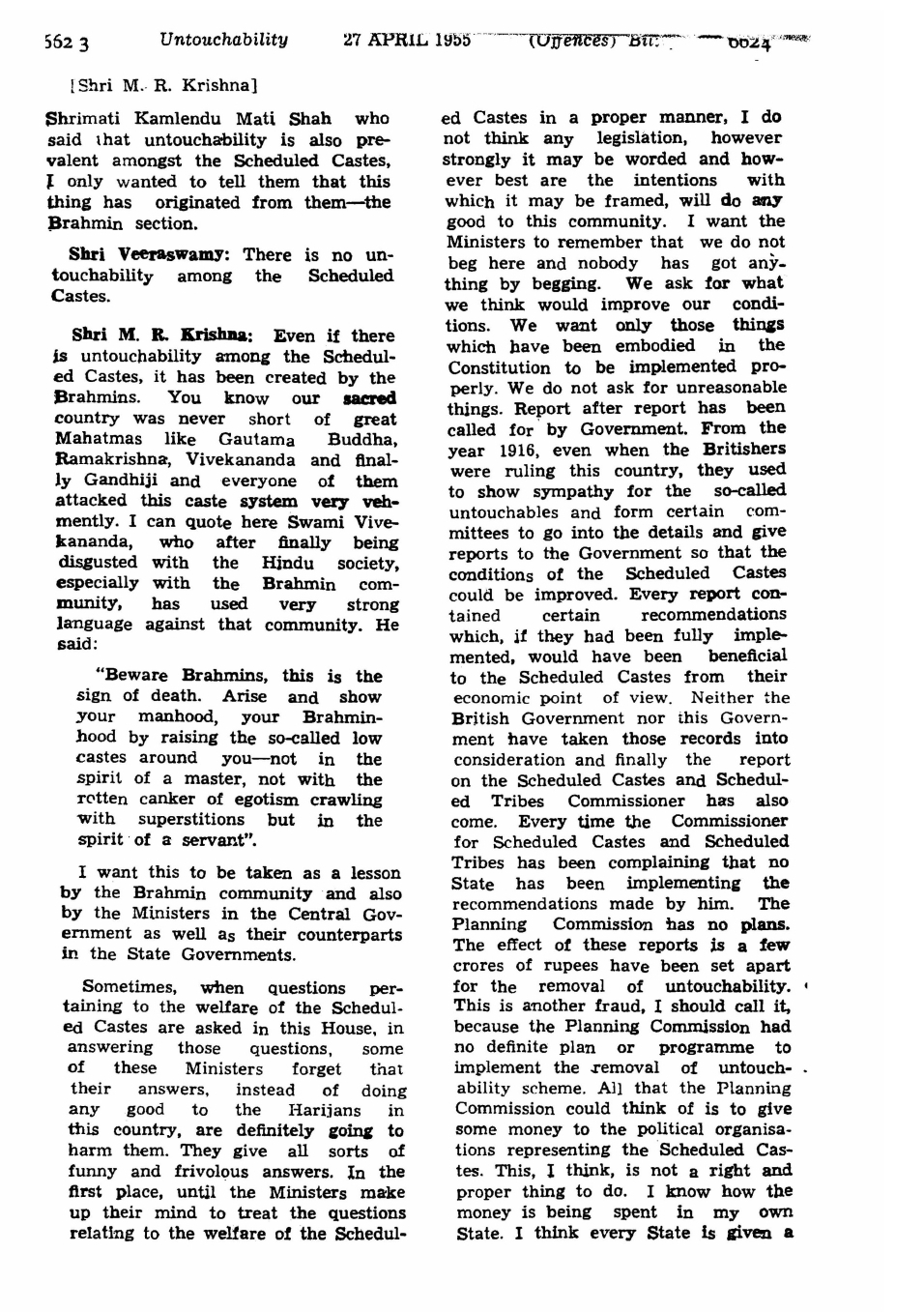
In perhaps the most direct indictment of the Nehru government, M.R. Krishna chastised the ministers for not taking Dalits seriously, stating that no legislation would “do good to this community” absent commitment to implement the law. He said of the Dalit community “We do not beg here… we only want those things which have been embodied in the Constitution to be implemented properly”. He bemoaned the fact that while the colonial and post-colonial governments of India had commissioned several reports to study the untouchability problem, little had been done to implement the recommendations of such reports, especially with regard to the economic upliftment of Dalits. He charged the Planning Commission with “fraud”, arguing that the little amount of money they had set aside for Dalit welfare had been spent on political organisations and “no definite plan or programme” was put in place to “remove untouchability.” He argued that the insincerity of the government was apparent in that untouchability prevailed even in the Defence services, where it would have been easier to impose discipline. And yet he stated that he believed Home Minister Pant to be sincere in his intentions.[21]
With Home Minister Govind Ballabh Pant, cheering on the law, the general sentiment in both houses was that while the bill was a significant step forward, eradicating untouchability would require propaganda against the practice by the government. Dalit MPs and others had repeatedly stressed the need for wide ranging economic and administrative reforms to ensure that untouchability would be abolished as a simple penal law would be insufficient.[22]
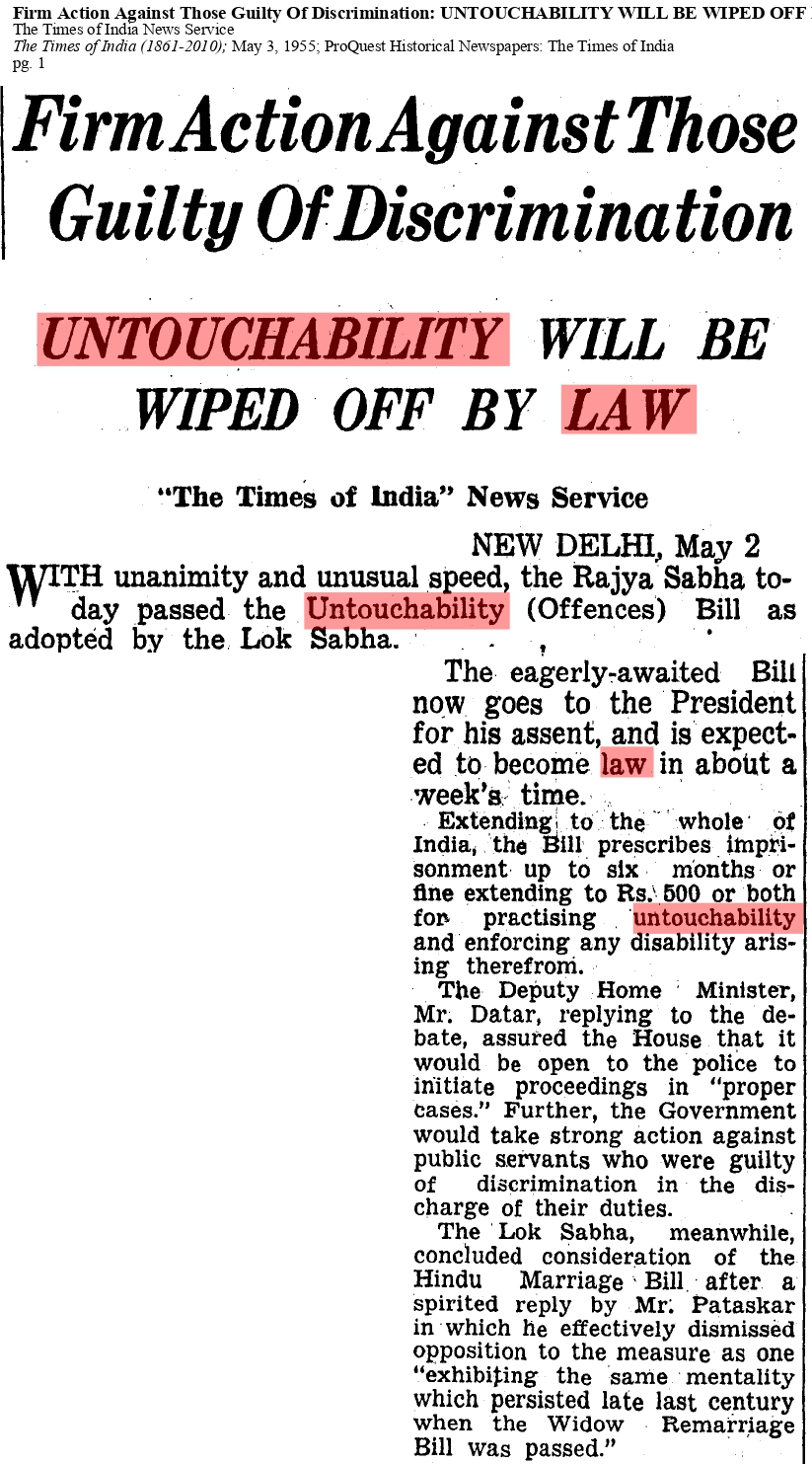
The UOA, in its final form, was approved by both houses and sent to the President for assent on 2nd May 1955.[23]
Not four months after the passing of the UOA, Govind Ballabh Pant, who championed the act, stated in parliament that the steps taken by the government so far were inadequate and that more substantial action in the form of social propaganda, the establishment of central boards to monitor the welfare of Dalits, the inclusion of Dalits in the public services, reserved seats in state legislatures, and free education in schools and universities for Dalit students was necessary.[24]
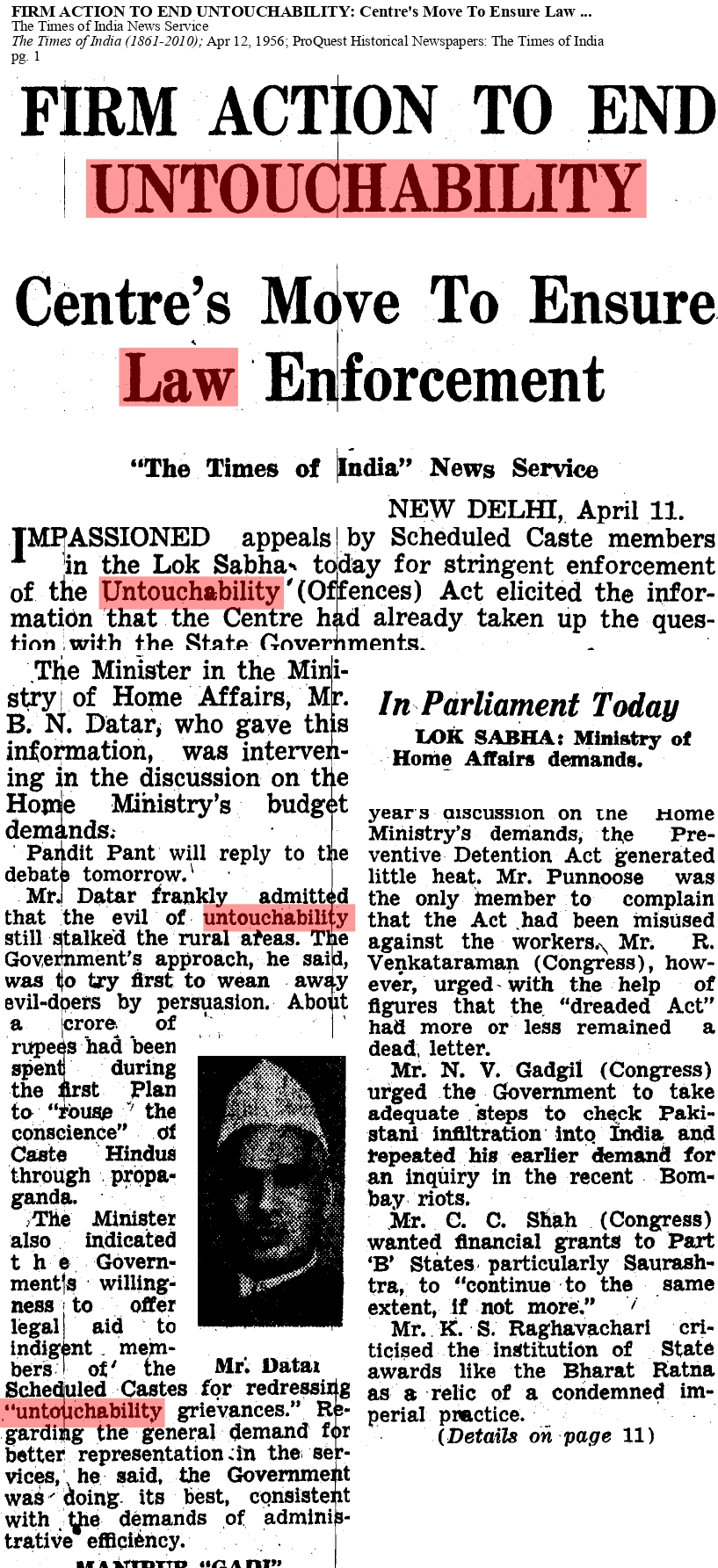
A year later, B.N. Datar admitted in parliament a year that the “evil of untouchability stalked the rural areas”. He pointed out that the untouchability was stubborn in that it persisted despite spending one crore of the government’s money on propaganda against untouchability.[25]
[1] ‘Punishment for Practicing Untouchability: Proposal to Refer Bill to Joint Committee’ The Times of India (27 August 1954) 7. ‘Untouchability Bill to be referred to Select Body: Plea for Ban on Offenders Entering Public Bodies’ The Times of India (18 September 1954) 10.
[2] ‘Need Stressed to Establish New World Order: Untouchability Bill Discussion’ The Times of India (31 August 1954) 8.
[3] B.R Ambedkar, Rajya Sabha Debates (16 September 1954) 2443; P.T. Leuva,Rajya Sabha Debates (17 September 1954) 2536-38; ‘Untouchability Bill to be referred to Select Body: Plea for Ban on Offenders Entering Public Bodies’ The Times of India (18 September 1954) 10.
[4] B.N. Datar, Rajya Sabha Debates (17 September 1954) 2613.
[5] A.K.Gopalan, Lok Sabha Debates (Vol.4, 1954, 27 August 1954) 444-446.
[6] Laskar, Lok Sabha Debates (Vol.4, 1954,31 August 1954) 637-638.
[7] K.S. Rao, Lok Sabha Debates (Vol.4, 1954,27 August 1954) 451-452.
[8] Bogawat and Ram Das, Lok Sabha Debates (Vol.4, 1954,30 August 1954) 542-543.
[9] K.L.Balmiki, Lok Sabha Debates (Vol.4, 1954,31 August 1954) 683.
[10] Khardekar, Lok Sabha Debates (Vol.3, 1955,27 April 1955) pp.6565
[11] Report of Joint Committee, Untouchability Offences Bill, Lok Sabha (December 1954) ix-xi
[12] N. Rachiah, Lok Sabha Debates (Vol.4, 1954,27August 1954)464,460
[13] S.S. More, Lok Sabha Debates (Vol.3 1955,27 April 1955) 6592.
[14] Khardekar, P.N. Rajbhoj, K.S. Rao and Kakkan, Lok Sabha Debates (Vol.3, 1955 27April 1955) 6564,6570,6572,6594.
[15] S.N. Majumdar, Rajya Sabha Debates, Untouchability Offences Bill, 1955, (2 May 1955) 6519.
[16] D. Narayan, Agnibhoj, Rajya Sabha Debates, Untouchability Offences Bill, 1955 (2 May 1955) 6527,6537
[17] Report of Joint Committee, Untouchability Offences Bill, Lok Sabha (December 1954)
[18] ‘Pandit Pant Cheered: Lok Sabha Untouchability Bill Moved’ The Times of India (28 April 1955) 1. ‘Call to Exorcise Demon of Untouchability: Bill to Punish Offenders discussed in Lok Sabha’ The Times of India (28 April 1955) 7.
[19] Kakkan, P.N. Rajbhoj, N.C. Chatterjee, Lok Sabha Debates (Vol.4, 1955,27 April 1955) 6573,6597,6601,6611.
[20] R Agnibhoj, Govinda Reddy, Rajya Sabha Debates, Untouchability Offences Bill, 1955 (2 May 1955) 6538,6591.
[21] M.R. Krishna, Lok Sabha Debates (Vol.3, 1955,27 April 1955) 6624-6627.
[22] ‘Pandit Pant Cheered: Lok Sabha Untouchability Bill Moved’ The Times of India (28 April 1955) 1. ‘Punishment for Practice of Untouchability: Bill Passed Amidst Cheers from All Sections’ The Times of India (3 May 1955) 8.
[23] ‘Affirm Action against those Guilty of Discrimination: Untouchability to be wiped off by Law’ The Times of India (3 May 1955) 1.
[24] ‘Govt Measures Inadequate, Admits Pandit Pant: More Vigorous Drive to Improve Harijans Lot’ The Times of India (17 September 1955) 1.
[25] ‘Firm Action to End Untouchability: Centre’s Move to Ensure Law Enforcement in Parliament Today Lok Sabha: Ministry of Home Affairs Demands’ The Times of India (12 April 1956) 1.
 The Article 17 Project
Leave a comment