Defining Untouchability
The question of defining untouchability became important in the context of the temple entry provision postulating that Dalits would only be entitled to temple entry where Caste Hindus of the same denomination and sect were allowed entry. P.T. Leuva first pointed this out in the Rajya Sabha, arguing that temple entry should not be limited on account of denomination or sect.[1]
However, there was steep resistance from Hindu legislators and the government, who feared this change would allow religious converts access to temples. R.K. Chaudhari for example argued that “it is all very right to allow people who really and sincerely profess the Hindu religion and believe in idol worship and worshipping the deity to go inside the temple. It is criminal, I say, it is immoral, I say, to prevent those people from going to the temples. But what about people who do not believe in this religion, who say Idol worship is adultery? ….why should any person allow these people into the temple?… those people go there merely to enforce their right and they do not believe in the faith of any religion.” .[2] In this way Hindu legislators grounded their reservations in concerns about religious rights and respect for religion.
In response Dalit parliamentarians like Khardekar contextualised temple entry as being about access to public spaces. “But the point here is one of a public space of worship. Nobody would like to invade his house or disturb his privacy. Now in a public place of worship, all high caste Hindus are allowed. Is the presumption in favour of their morals? is every Hindu who goes to the temple a very faithful devotee of god and does he go there with all the best intentions? … The presumption that untouchables go to temples without faith and so on is not a correct assumption.”.[3]
As R Velayudhan put it the parliament was tasked with protecting Hindus and Non Hindus from untouchability, and also balancing religious interests in keeping Hindu temples exclusive. “Somehow or other we shall have to find a suitable word which will exclude the Muslims and other Non-Hindus… this is a matter of law. If we do not include this definition of untouchable, the whole law will become ineffective when it goes before a court…. you are thinking in terms of non-Hindus getting into a Hindu temple. But what about the major number of people who are suffering from the evil of untouchability?… what is the legal protection for them? That is why I suggested that a suitable wording should be found so that we can give protection and at the same time see that non-hindus are prevented from getting into Hindu temples. I do not want that Christians and Muslims should get into Hindu temples even though I personally like it very much. “ [4]
In the end this issue came to be seen as relatively minor and a compromise was reached. The law instead of defining untouchability with reference to who is subjected to it, simply penalised the imposition of religious and social disabilities on the ground of “untouchability” by one person on another. This decision more closely follows the mandate of Article 17 which simply abolished untouchability without categorising any class of people as specifically vulnerable.
However, An explanation was added to section 3 that penalised imposition of religious disabilities that stated that Buddhists, Sikhs, Jains, and followers of sects of Hinduism like Virashaivas, Lingayats, Arya Samajists and Swami Narayan Sampradaya would all be considered Hindus if they were to prevent temple entry to Dalits or impose civil disabilities on Dalit citizens. The question of Muslim or Christian Dalits was left unanswered.
The import of this choice, however, was that position of Muslim and Christian Dalits was tenuous with regard to their inclusion in the protections offered by the UOA. On the one hand, sympathetic judges would be free to include Dalits of any religious persuasion within the ambit of the law as only the imposition of social and religious disabilities by one person against another was penalised. On the other hand, a less eager judge could be persuaded that any alleged act of untouchability committed against Muslim and Christian Dalits was committed on the ground of religion and not on the ground of “untouchability”.
Another disagreement with regard to the definition was whether the law would be strengthened by providing a definition the courts would not be able to ignore, or whether the law would be strengthened by leaving untouchability undefined so as to not limit judicial discretion to punish untouchability when they saw it.
R. Velayudhan, in his dissenting note to the joint committee, hinged much of his criticism of the bill on the lack of a definition of “untouchability”. Arguing that without an adequate definition, courts and judicial officers he described as belonging to the “offending class” would be free to render the bill a dead letter.[5] Even when the bill was reintroduced in parliament, he requested that it be circulated for public opinion again. He reiterated arguments about temple entry and that “untouchability” and “untouchables” needed to be explicitly defined in the bill to cover Dalit religious converts. He was joined in his concerns by SS More, Gurupadasamy, Sadhan Kumar Gupta, and others who moved amendments that defined “untouchables” as anyone who was designated schedule caste by Article 366 of the Constitution or through any custom, regardless of if they had migrated from one part of the country to another or if they had converted to another religion but were ultimately unsuccessful.[6]
G.B. Pant, responding for the government, argued that adding a definition of untouchability or “untouchable” could be counter-productive as courts might then require complainants to prove they qualified under such definition and that the offence committed against them qualified as untouchability. Better to leave these terms undefined and not restrain judges. Additionally, since the Constitution had abolished untouchability, it would be inappropriate to stigmatise any person by defining them as untouchable.[7]
B.N. Datar responded for the government in the Rajya Sabha, arguing that the “untouchability” was left undefined because the parliament did not want to impose a limitation on what would be considered untouchability and trusted the courts to know it when they saw it.[8]
Is Untouchability A Rural Issue?
In introducing the UOA to the Lok Sabha, Minister for Home Affairs, K. N Katju explicitly states that “in the urban areas, there is not much of untouchability left, because there is a good deal of political consciousness…” but that the issue “still persists in rural areas.”[9]
This sentiment was only echoed by T.S.A Chettiar.[10] Other members of parliament, including A.K Gopalan,[11] Laskar, M.B. Vaishya,[12] and Sardar Hukam Chand[13] repeatedly reminded the government that untouchability thrived in their own backyard, citing instances of Dalits being subjected to untouchability in the offices of a Magistrate in New Delhi, on Parliament Street.
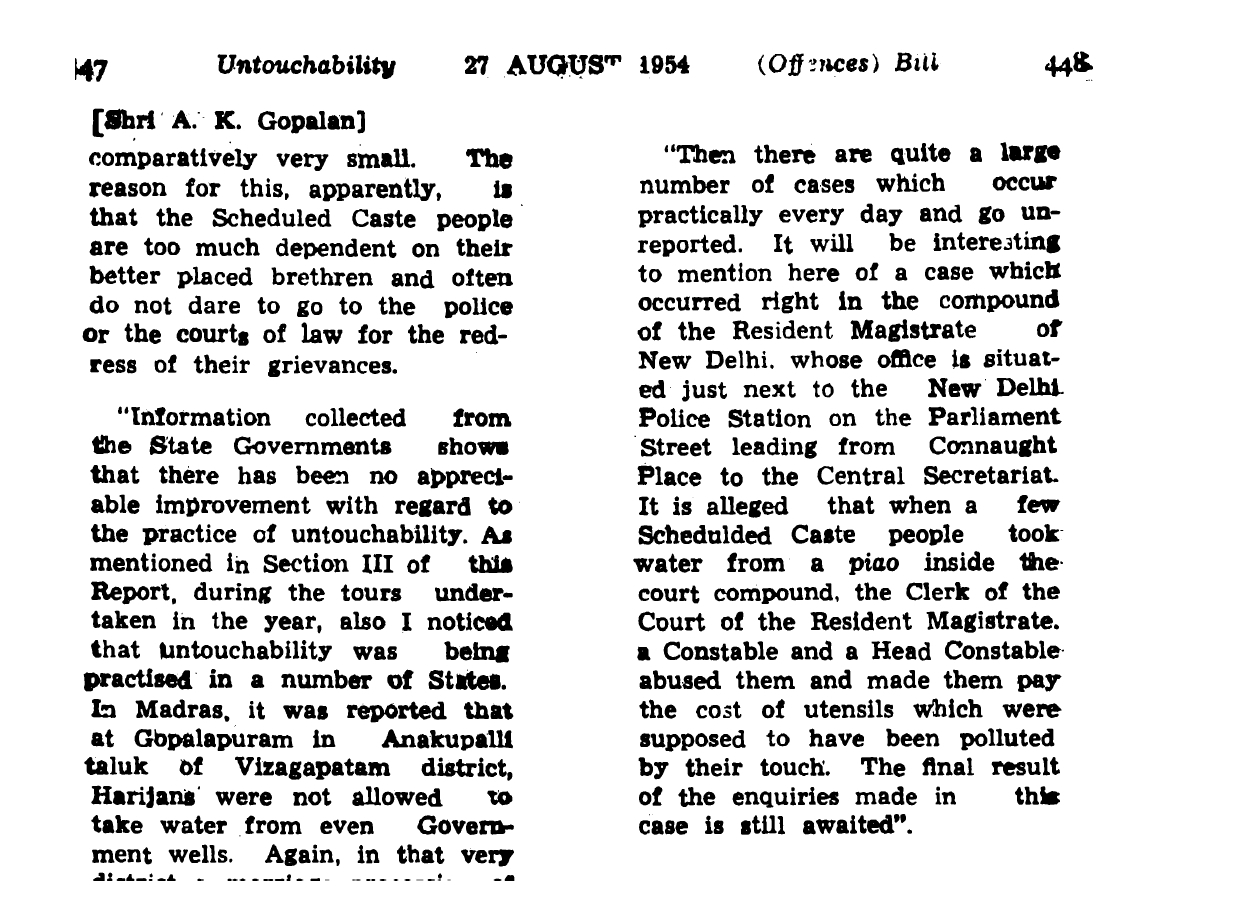
Ashoka Mehta cited the L.M Shrikant report to note that Dalits in major cities like Hyderabad lived in pitiable conditions in slums without electricity, water or sanitation and that Dalit manual scavengers in cities were particularly oppressed.[14]
Purushottam Das Tandon also pointed out that Dalits were forced to engage in manual scavenging in cities like Delhi, Allahabad, and Lucknow and that the bill failed to address this form of untouchability.[15]
Kanhaiyya Lal Balmiki relayed a personal story of how a Caste Hindu friend who had shared sweets with him was beaten by his uncle, a professor at a well-known university in North India, arguing that untouchability was perhaps practiced most severely by educated classes.[16] He added that sweepers in Delhi Municipality were forced to clean by police officers due to an essential services ordinance.[17]

D.C. Sharma and R. Velayudhan noted that Delhi University and Central Institute of Education were resisting providing Dalit students with aid.[18]
S.N. Agarwal argued that while untouchability was prevalent in rural areas, it took on new forms in urban spaces through housing discrimination.[19] Laskar argued that the difference was one of degree and not of kind, and while untouchability was practised in urban areas, conditions in rural areas were worse.[20]
When B.N. Datar repeated similar claims about untouchability being confined to rural areas in the Rajya Sabha, P.T. Leuva attempted to disabuse him of the notion by relaying his own experiences in facing housing discrimination in Bombay.[21]
In the final reading of the bill before the Rajya Sabha, D Narayan reflected on the experience of anti-untouchability legislation in the Bombay province and argued that while those laws had been moderately successful in uplifting Dalits in urban areas, the economic dependence of Dalits on Caste Hindus in rural areas made enforcement via simple penal statutes particularly difficult, a sentiment echoed by many other lawmakers. [22]
Anup Singh and Govinda Reddy in turn pointed out that untouchability was practiced not just in rural areas but even by members of parliament, the official class, and the educated, white collar class.[23]
While this conflict was never addressed more substantially, a certain continuity with colonial imaginations of the rural poor needing to be educated and civilized through criminal law had seeped into the attitudes of the government of independent India, perhaps leading to the erasure of everyday routine marginalization and discrimination prevalent in urban centres.
[1] P.T. Leuva, Rajya Sabha Debates Untouchability Offences Bill (17 September 1954) 2517-2519.‘Untouchability Bill to be referred to Select Body: Plea for Ban on Offenders Entering Public Bodies’ The Times of India (18 September 1954) 10
[2] R K Chaudhari, Lok Sabha Debates (Vol.3, 1955,28 April 1955) 6696,
[3] Khardekar, Lok Sabha Debates (Vol.3, 1955,28 April 1955) 6717-6719,
[4] R Velayudhan, Lok Sabha Debates(Vol.3, 1955,27 April 1955) 6656.
[5] Report of Joint Committee, Untouchability Offences Bill, Lok Sabha (December 1954) ix-xi
[6] Lok Sabha Debates (Vol.3, 1955,27 April 1955) 6639-6651, ‘Call to Exorcise Demon of Untouchability: Bill to Punish Offenders discussed in Lok Sabha’ The Times of India (28April 1955) 7.
[7] G.B. Pant, Lok Sabha Debates(Vol.3, 1955,27 April 1955) 6666-6671.
[8] B.N. Datar, Rajya Sabha Debates, Untouchability Offences Bill, 1955 (2 May 1955)
[9] K.N. Katju, Lok Sabha Debates (Vol. 4, 1954 26 August 1954) 404-405
[10] T.S.A. Chettiar, Lok Sabha Debates (Vol.4, 1954, 27 August 1954) 458
[11] A.K.Gopalan, Lok Sabha Debates (Vol.4, 1954 27 August 1954) 448
[12] Laskar and M.B. Vaishya, Lok Sabha Debates, (Vol.4, 1954,30 August 1954) 554-555.
[13] Sardar Hukum Chand, Lok Sabha Debates (Vol.4, 1954 31 August 1954)663 662
[14] Ashok Mehta, Lok Sabha Debates (Vol.4, 1954,31 August 1954) 665.
[15] Purushotham Das Tandon, Lok Sabha Debates (Vol.4, 1954, 30 August 1954) 558-560.
[16] K.L. Balmiki, Lok Sabha Debates (Vol.4, 1954 31 August 1954) 681.
[17] K.L.Balmiki, Lok Sabha Debates (Vol.4, 1954 31 August 1954)682
[18] D.C. Sharma and R. Velayudhan, Lok Sabha Debate (Vol.4, 1954 31 August 1954) 707-708.
[19] S.N. Agarwal, Lok Sabha Debates (Vol.4, 1954,30 August 1954)549-550.
[20] Laskar, Lok Sabha Debates(Vol.4, 1954 31 August 1954) 633.
[21] P.T. Leuva, Rajya Sabha Debates Untouchability Offences Bill (17 September 1954) 2535.
[22] D. Narayan, Rajya Sabha Debates, Untouchability Offences Bill, 1955 (2 May 1955) pp.6527,6537.
[23] Anup Singh and Govinda Reddy, Rajya Sabha Debates, Untouchability Offences Bill, 1955( 2 May 1955) 6581,6587.
 The Article 17 Project
Leave a comment