In the immediate aftermath of the making of the Constitution, one sees some optimism among lawmakers and activist organisations regarding the project of untouchability. The All India Depressed Classes League in 1949 called the abolition of untouchability in the constitution a guarantee of “civil rights of the depressed classes” [1] But there are increasing reports of harassment and deterioration in conditions of Dalit citizens.[2] A bitter fight broke out in Maharashtra regarding the applicability of the Bombay Harijan Temple Entry Bill, 1947 to Jain temples. Orthodox Jains argued that Jainism was distinctly separate from Hinduism and that the provisions of the temple entry legislation did not apply to them.[3] By the next year, newspaper editorials were arguing that the abolition provision in the constitution was ineffectual in securing civil rights without legislation. Explicit comparisons were made to segregation in the United States of America.[4]
In 1951, following reports of physical assaults, economic boycotts and social ostracism in Punjab and Gujarat, Dr Ambedkar attacked the government in the press as indifferent to the plight of the Harijans, explicitly comparing the British regime to the Nehru Government.[5] President Rajendra Prasad was compelled the following year to call for All-India legislation on untouchability as provincial legislation was found to be ineffectual.[6] Jagjivan Ram also called for such legislation in 1952, stating that customs and prejudices were being enforced more rigidly than laws enacted by the parliament. In this speech, he pushed for legislation on minimum wages, and the inclusion of Dalits in government jobs, and argued against the conversion of Dalits to Buddhism.[7] At the same labour conference, Jawaharlal Nehru tied the cause of caste and class together, arguing that equality of opportunity would go toward ending exploitation and calling for agrarian reforms.[8]
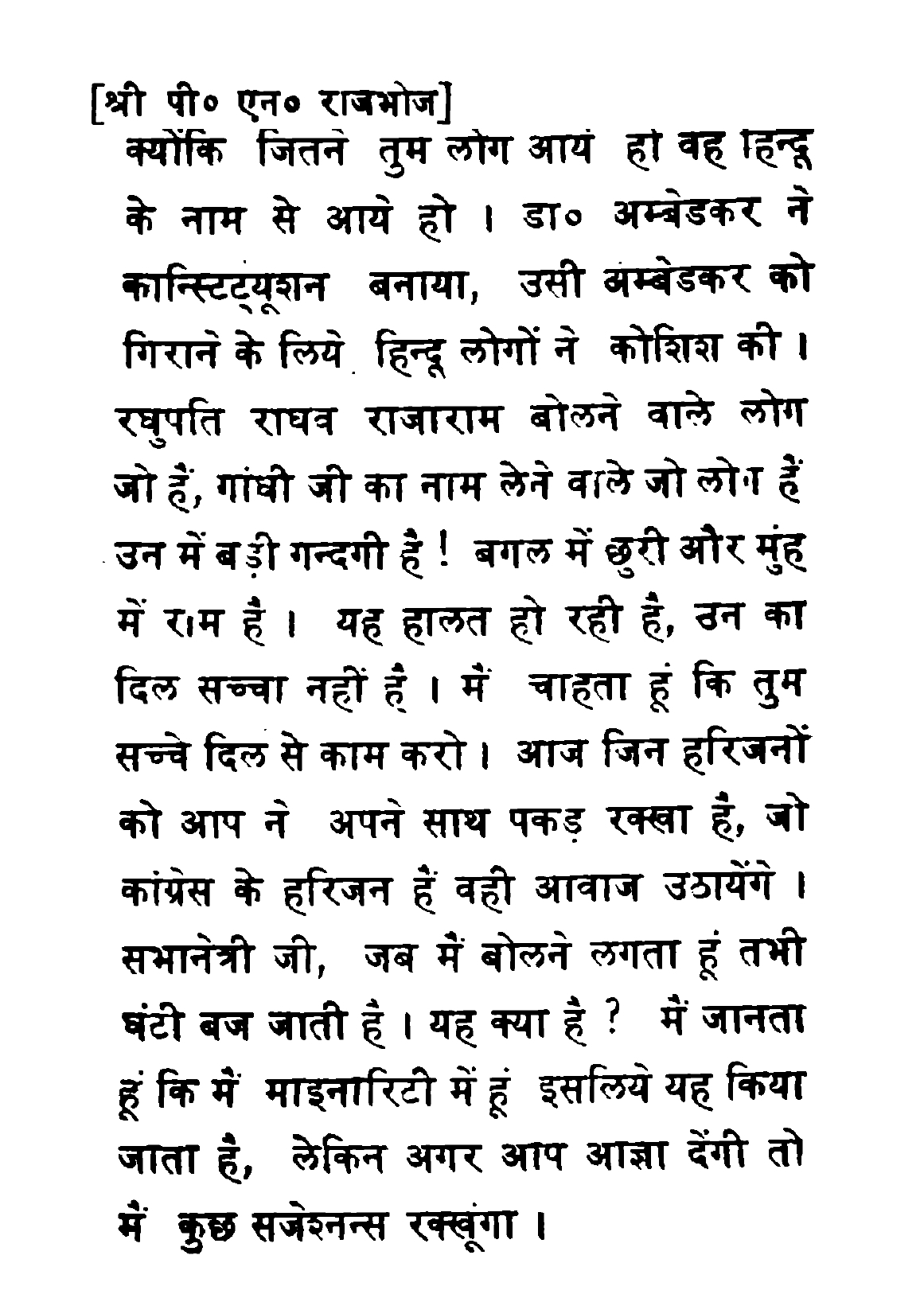
By 1953, the exit of Dr. Ambedkar from the law ministry over the contentious Hindu Code Bills and continued dissatisfaction with the legislative movement on untouchability had animated members of parliament, and they began to nudge the government to pass an untouchability law. MP Minimata from the Congress party moved a “non-official motion” on enacting a comprehensive law to deal with the problem of untouchability. Dalit members of the house, like P.N. Rajbhoj, argued that Nehru was hypocritical for speaking on the apartheid problem in South Africa when “ You find a South Africa in every village and every nook and corner of India”. He directly accused the Prime Minister stating “ Dr. Ambedkar drafted the constitution and you have gotten rid of him.”
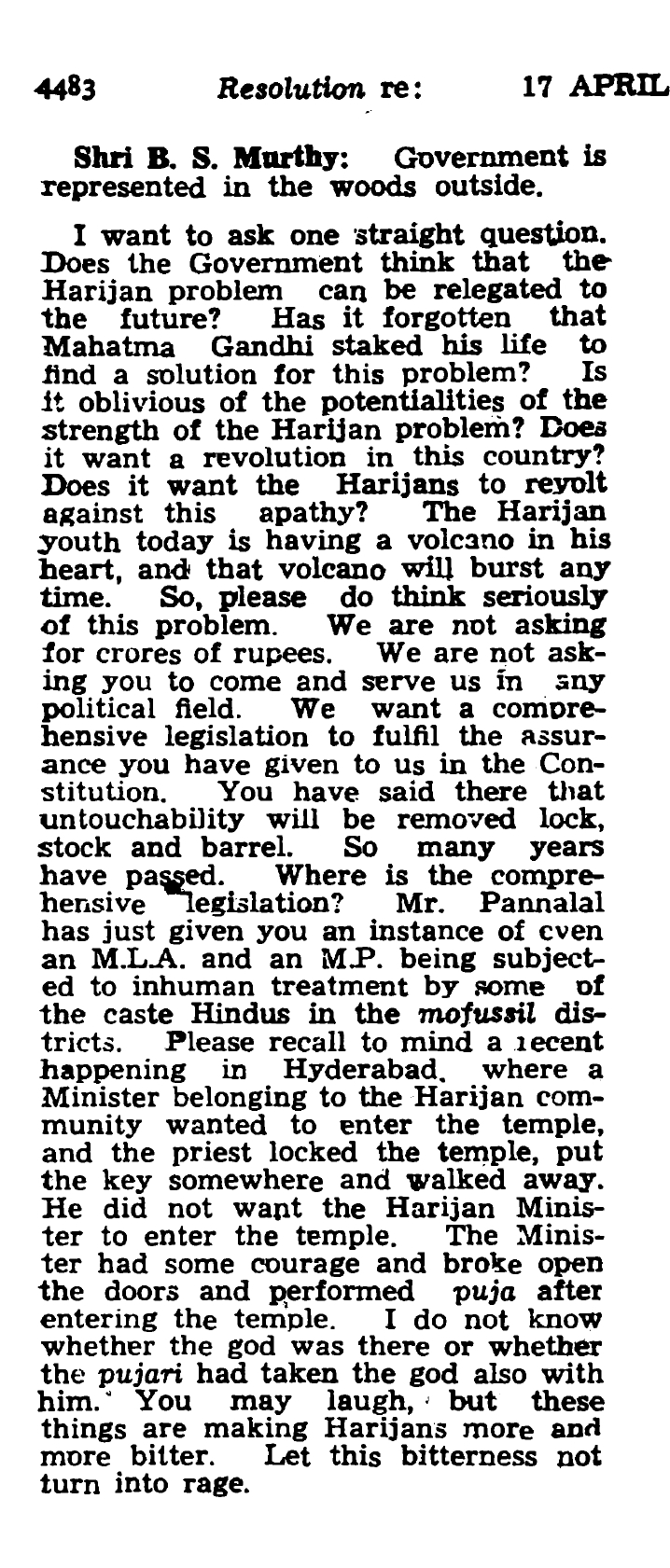
B.S. Murthy, a member of the Praja-socialist party, stated “Every Harijan youth has a volcano in his heart… that will burst one day… Now that Gandhiji is dead, untouchability lives.”
Representatives of the government sought to placate these concerns by pointing out that while they were working toward an All-India legislation on the issue, practically every state had enacted laws making untouchability a cognisable offence.[9] This conversation was largely repeated when another congress representative, S.N. Das, proposed a similar motion in parliament a few months later. [10]
An editorial written following this controversy recounted how Dalit members of parliament had recently come out stating that they had faced untouchability while being served tea at a shop. The article argued that eradicating untouchability would require more than just laws and would require economic upliftment of the Harijan community,[11]
A report by L.M Shrikant, the commissioner for Scheduled Castes and Tribes was presented in parliament in August of 1953 which unequivocally stated untouchability continued to persist despite Article 17 of the Constitution, and despite state legislation. The report argued that the eradication of untouchability would take time as Dalits had to become economically independent to have the courage to break social barriers. It called the assertion of equal rights by Harijans a hopeful sign of a “silent revolution in society”. It urged the union government to engage in “propaganda” work to change minds and root out societal prejudice in addition to the provision of housing, drinking water, security of land ownership, debt redemption, improvement of sanitation, legal aid, and representation in local bodies and panchayats to Dalit citizens.[12]
When the report was discussed in parliament, Dalit MPs excoriated the government for what they viewed as inadequate and apathetic response to the untouchability problem. And proposed several motions in the the Lok Sabha to “regret the apathy shown by the government” in addressing problems of Dalits and Adivsis, to regret that the government has not adequately addressed economic backwardness among Dalits, to spend 10 crores on economic upliftment of Dalits, to set up a separate ministry for Dalit welfare, to set up backward classes welfare departments at the states, to set up a parliamentary committee to study the untouchability problem, to fill vacancies in reserved posts in government, to address landlessness among Dalits with a rehabilitation program, to provide scholarships for Dalit students etc.[13]
By the end of the year, a draft of the UOA had been circulated to the states and was expected to be introduced in the next parliamentary session.[14] This bill was ambitious to start with; It threw open all temples to Dalits who belonged to the same religion and denomination as any other person allowed access to them, it threw open access to wells and tanks, and it explicitly enumerated a range of public spaces where caste-based exclusion was illegal.
It banned social boycotts and declared that the imposition of caste disabilities would be a cognizable offence punishable with six months in prison and a fine of 500 rupees or both.
The bill went further and allowed for holding private corporations accountable through their directors and officers for any imposition of disability in private companies. It also proposed that a professional holding a license for any profession was liable to have such a license revoked if found guilty under the act.
It explicitly forbade courts from recognising customs and usages that would impose civil disabilities on grounds of caste, and lastly, it defined an “untouchable” as a member of a scheduled caste, regardless of whether he migrates to another locality or if he converts from Hinduism to any other religion.
True to its word, the Union government moved the bill in parliament in March 1954.[15] By August of that year, the bill was referred to a Joint Committee with the Home Minister K.N. Katju reiterating that the government had been committed to rooting out untouchability while warning that legislation would not be enough and public opinion on untouchability would need to change.[16]
B.N. Datar introducing the legislation at the final reading of the Bill in the Rajya Sabha argued that a union legislation on untouchability was a necessary response to colonial courts enforcing “custom” that imposed caste disabilities on “citizens of India” “entitled to fundamental rights”[17]
Three conflicts emerge in the parliamentary discussion of the UOA. First, how untouchability was to be defined in the context of religious rights, legal design, and as a rural or urban problem . Second, whether the UOA was to be understood as a civil rights law or a penal law that punished the practice of untouchability, whether the abolition of untouchability required more expansive legislation aimed at economic and educational upliftment, the eradication of caste, and subsequent commitment of government resources rather than introducing social reform through piecemeal penal legislation. And third, whether legal and administrative institutions inherited from the colonial era could be trusted to implement the law, indeed whether the union government itself was taking the untouchability issue seriously.
The next three posts will deal with them in turn
[1] ‘Depressed Classes and Constitution, Times of India’ (29 November 1949) 1.
[2] ‘A Good Harvest: Harijans Tale of Woe: Gujarat Newsletter’ Times of India (17th October 1949) 6; ‘The Harijans’ Times of India (30th September 1949) 8.
[3] ‘Inclusion of Jains Among Hindus: Objection to New Act Untenable’ Times of India (20th August 1949) 5 ; Manisha Sethi, ‘Jainism in Danger? Temple Entry and the Rhetoric of Religion and Reform in Post-Colonial India,’ Modern Asian Studies (2020).
[4] ‘Law and Civil Rights’ Times of India (11 June 1950) 8.
[5] ‘Harijans Plight’ Times of India (3 July 1951) 4.
[6] ‘Backward Classes’ Times of India( 25 May 1952) 6.
[7] ‘Enforce Measures to End Harijans Disabilities: Mr. Jagjivan Rams Urges Crusade Against Caste’ Times of India (1st November 1952) 9.
[8] ‘The Harijans’ Times of India (3 November 1952) 6
[9] ‘Steps towards removal of untouchability: Lower House adopts non-official motion’ Times of India (18 April 1953) .
[10] ‘Numerous Handicaps Suffered by Harijans in States: Minister Assures Drastic All India Legislation’ Times of India (18 April 1953) 11
[11] BGV, ‘Eradicating Untouchability’ Times of India (19 April 1953) 14.
[12] Ministry of Home Affairs, Government of India, Report of the Commissioner for Scheduled Castes and Scheduled Tribes For the Year 1953, ‘Legislation to Penalize Untouchability Urged: Report on Condition of Backward Classes’ Times of India (6 August 1953) 8.
[13] Lok Sabha Debates, “Report of the Commissioner for Schedule Castes and Schedule Tribes” (17 December 1953) 2453-2469
[14] ‘Drastic Bill to Root out Untouchability Practice Punishable with Jail, Fine, Special penalties for Ostracism’ Times of India (31 December 1953) p.1.
[15] ‘New Deal for Harijans: Bill Moved Untouchability is Punishable,’ The Times of India (16 March 1954) 1.
[16] ‘Punishment for Practicing Untouchability: Proposal to Refer Bill to Joint Committee’ The Times of India (27 August 1954) 7.
[17] B.N.Datar, Rajya Sabha Debates, Untouchability Offences Bill, 1955 (2 May 1955) 6491.
 The Article 17 Project
Leave a comment