In part 1 of this series we delved into the archives of the Sub Committee on Fundamental Rights to find that the legislative history behind the creation of Article 17 was more contentious than previously thought. We discussed Dr. Ambedkar’s “States and Minorities” proposal and the arguments he made for criminalisation of untouchability to allow for the protection and exercise of Dalit civil rights.
In this part, we will discuss deliberations at the Sub-Committee on Minorities and the Advisory Committee of the Constituent Assembly.
H.J. Khandekar pens a “Memorandum on Minorities” on April 2nd, 1947, in which he is quite scathing in his criticism of Article 17 as it was then formulated. He alleges that Dalit citizens are being ignored because of the perception that they are less populous and powerful.
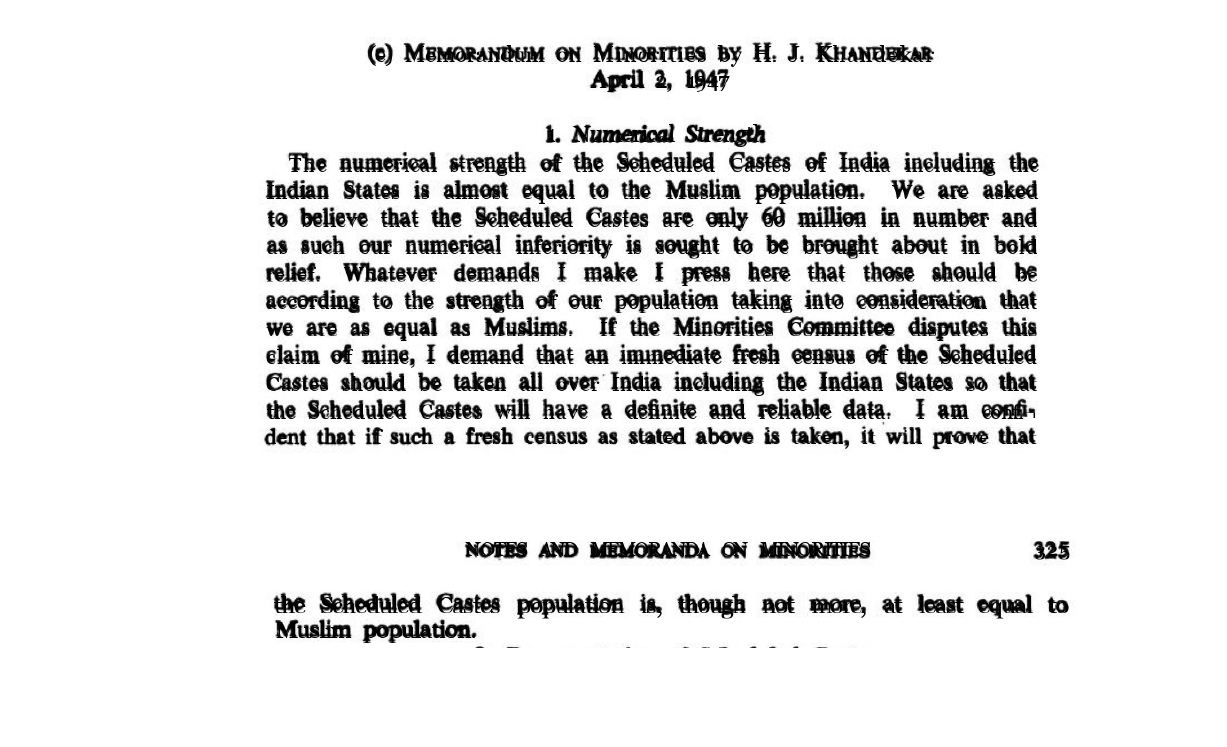
He asks for a fresh census and the establishment of a monitoring commission headed by a mix of Supreme Court judges and lawmakers that would investigate laws, rules, and acts of administration that operated against minorities and invalidate them.
He proposes the following framing for an untouchability provision: “Observance of untouchability in any shape or form by any person in public places, places of public worship, public institutions and places established or maintained at public cost or for the use of public should be regarded as a cognisable offence.” Pushing for the criminalisation of untouchability.
All this is in addition to proposing a charter of rights for Dalit citizens in the same vein as “States and Minorities,” including resettlement, quotas in public employment and education and for the state to fund the creation of wells, tanks, hydrants for drinking water for Dalits and for the state to set aside funds to provide housing for Dalits.
But this, too, does not get a response within the sub-committee meetings, and the conflict is left unresolved.
Both Dr Ambedkar and Khandekar, through their demands for criminalisation and for new state machinery solely dedicated to eradicating untouchability, demonstrate a deep distrust of the intentions and abilities of legal and administrative institutions of the colonial state.
Another conflict played out in the SCM and the Advisory Committee that queried the question of whether acts of private persons would count as untouchability and whether religious discrimination, the mistreatment of Muslims and Christians (many of them Dalit converts) by Caste Hindus as untouchables, was to be included in the definition of untouchability.
On April 17, 1947, Dr S.P. Mookerjee and Mr. Thakur asked the SCM to define “untouchability” clearly and exclude non-Hindus from its purview. On the same day, Mr. Khandekar insisted that the provision make clear that “private untouchability” was prohibited. These objections elicit no response, and the clause was approved as is the next day.
Following this, the Advisory Committee sits to deliberate on the reports submitted by the SCFR and the SCM. Discussion regarding the untouchability clause is quite tense, with Promotha Ranjan Thakur insisting that “untouchability” be restricted to discrimination within the Hindu fold as Muslims and Christians would be ritually untouchable to Caste-Hindus due to their religion. Manoj Mitta describes this interaction as the “Drama of Abolition” in his book “Caste Pride”
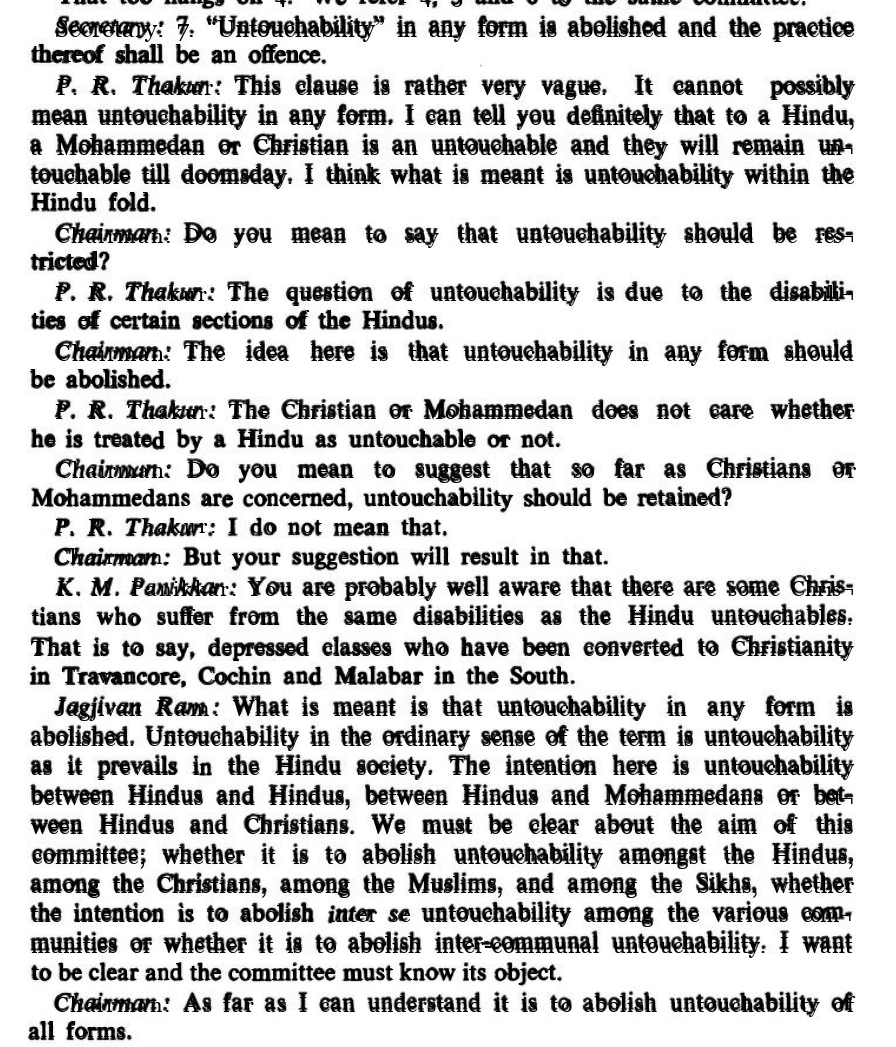
P.R. Thakur is interrogated by other members of the committee, chief among them the Chairman, Sardar Patel, who asks him if he wants to retain untouchability in so far as Muslims and Christians are concerned. P.R. Thakur, in this moment, demurs and says, “I do not mean that”. K.M. Panikkar chimes in to point out that some Christians suffer from the same disabilities as Hindu untouchables and provides examples of depressed classes who have been converted to Christianity in Travancore, Cochin and Malabar.
Jagjivan Ram initially states he agrees that Muslims and Christians must fall within the purview of the draft article, but states that there is a lack of clarity on the “intention behind the law”. Sardar Patel responds simply by stating that the “intention is to abolish untouchability in all its forms”.
A dramatised version of this conversation is portrayed in episode 5 of Shyam Benegals Samvidhaan titled “Strengthening the weak: Minority, Women, and Backward Rights”
Jagjivan Ram’s provocation on the lack of clarity behind the draft article leads to a discussion among the Advisory Committee on the nature of the abolishment. One interpretation is put forth by K.M. Pannikkar, who states that the object of the provision is to provide relief against civil disabilities imposed by untouchability since there can be no civil right against the individual practice of untouchability itself. Jagjivan Ram rejoins, arguing that the scope of the clause as drafted does not allow for this interpretation.
C Rajagopalachari puts forth an alternative interpretation that the draft article is intended to simply state that the law would not recognize any disability or right brought into existence by the practice of untouchability and that customs heretofore practised in the country are not to be respected thereafter. He suggested that the article be rephrased to reflect this idea of “imposition of disability.” A third interpretation, that the provision enjoins the state to create criminal laws to punish untouchability, was endorsed by Dr. Ambedkar and H.J. Khandekar, as noted in part 1.
This conversation ends in an impasse. On April 21st, 1947, the committee decided to redraft the clause as “ Untouchability in any form is abolished, and the imposition of any disability on that account shall be an offence”. This phrasing makes it into the Interim Report of the Advisory Committee on Fundamental Rights sent to the President two days later.
On 29th April 1947 Sardar Vallabhbhai Patel presented the interim report of the Advisory Committee on Fundamental Rights to the Constituent Assembly.
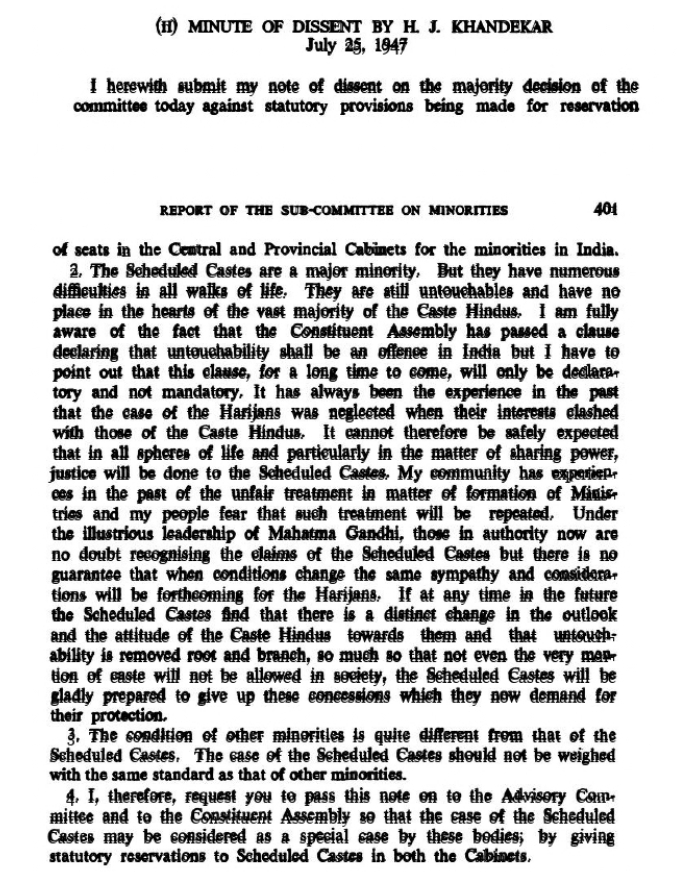
On July 25th 1947, H.J. Khandekar penned a minute of dissent to the advisory committee, while the note is geared toward criticising the Advisory Committees stance on reservations, he does mention the provision with regard to abolition of untouchability. He argued that the “Scheduled Castes” were a “major minority.” But yet they did not have a “place in the hearts of a vast majority of Caste Hindus”. He stated that because of these social conditions, Article 17 would only be “declaratory and not mandatory”. And argued that despite the recognition of Dalit rights claims due to the leadership of Gandhi, justice was still illusory.
References:
[1] B Shiva Rao, Framing of Indias Constitution, Selected Documents, Vol.2 See pages 200-204, 226-227, 287,297,325,401
[2] Manoj Mitta, Caste Pride: Battles for Equality in Hindu India (Westland Publications, Chennai, 2023) 294-296.
 The Article 17 Project
Leave a comment